Introduction
With the rapid growth of the aging population worldwide, healthcare systems are facing increasing pressure. One of the major challenges is the continuous monitoring of elderly patients, especially in nursing homes or assisted living facilities. Traditional healthcare systems often struggle due to limited staff and high costs.
Cloud computing has emerged as a powerful solution in the biomedical field, enabling real-time data processing, remote monitoring, and improved healthcare delivery.
Cloud Application in Biomedicine
This blog explores a cloud-native healthcare monitoring platform (CN-HMP) proposed by Amin et al. (2022). This system is designed to monitor elderly patients in real time using cloud computing and wearable health devices.
The platform collects vital health data such as heart rate, ECG signals, and respiration through wearable sensors. These data are then transmitted to a cloud-based system where they are analyzed and stored. Healthcare providers and family members can access this information through a web interface.
System Architecture
The CN-HMP system is based on a cloud-native architecture, which includes:
- Wearable health monitoring devices
- Edge devices (such as Raspberry Pi)
- A cloud platform for data processing and storage
- A web interface for users (doctors, nurses, and families)
The system also includes an alert mechanism that detects abnormal health conditions and notifies caregivers immediately.
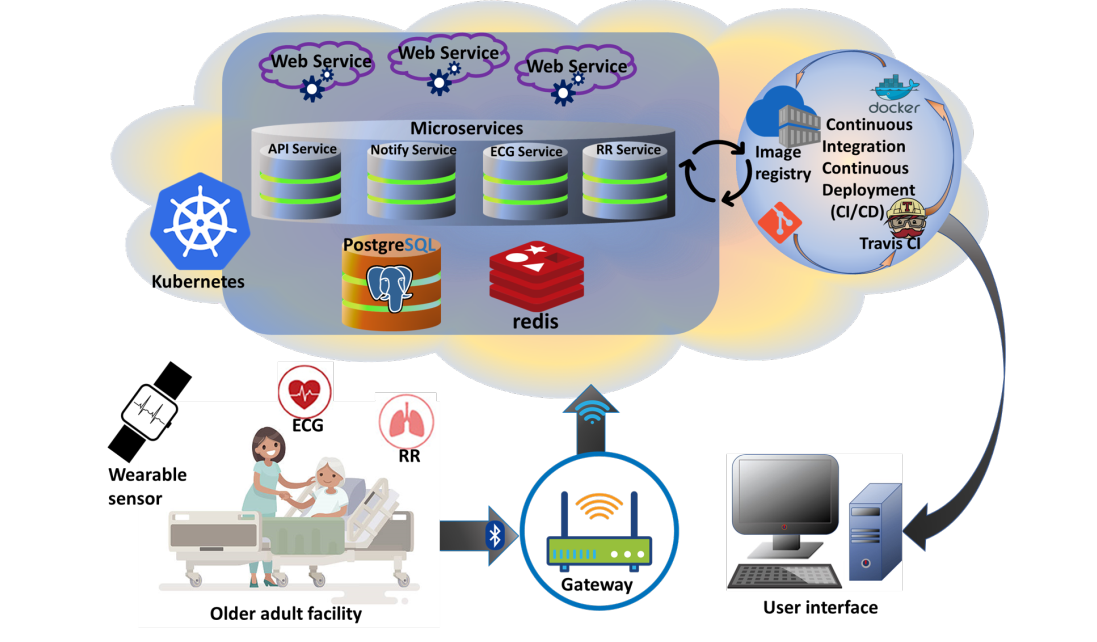
Figure 1: Cloud-native healthcare monitoring system architecture (CN-HMP).
Advantages of Cloud-Based Healthcare Systems
This application demonstrates several advantages of cloud computing in biomedicine:
- Scalability: The system can handle a large number of patients simultaneously
- Low latency: Data are processed almost instantly
- Accessibility: Information can be accessed remotely by healthcare providers
- Collaboration: Multiple stakeholders can access and share data
- Efficiency: Reduces workload for healthcare staff
Experimental Results
The authors tested the system in a real-time environment and compared it to traditional cloud systems. The results show:
- Response time below 0.1 ms for most requests
- No data loss during transmission
- Very low latency, even with large data volumes
These findings indicate that the cloud-native platform performs significantly better than traditional systems.
Discussion
The study highlights the importance of cloud-native architecture in modern healthcare systems. By using technologies such as microservices, containers, and Kubernetes, the platform achieves high scalability and efficiency.
This approach is particularly useful in elderly care, where continuous monitoring is essential and delays can have serious consequences.
Conclusion
Cloud computing is transforming the biomedical field by enabling advanced healthcare monitoring systems. The CN-HMP platform demonstrates how cloud-native technologies can improve patient care, reduce workload, and enhance system performance.
Such innovations are essential to address the growing challenges in healthcare, especially in aging populations.
References
Amin, A. B., Wang, S., David, U., & Noh, Y. (2022). Applicability of Cloud Native-based Healthcare Monitoring Platform (CN-HMP) in Older Adult Facilities. Annu Int Conf IEEE Eng Med Biol Soc. 2022 Jul;2022:2684-2688. doi: 10.1109/EMBC48229.2022.9871998. PMID: 36086197. Access the article